ASX Midcap 50 (XMD): Testing Upper Resistance with Strong Uptrend Momentum

What is the ASX MidCap 50 Index?
The S&P/ASX MidCap 50 (XMD) represents the performance of the 51st to 100th largest companies on the ASX by market capitalisation, sitting just below the blue-chip ASX 50. It offers a blend of established mid-sized firms with strong growth potential and sector diversity across financials, resources, industrials, healthcare and technology.
The XMD is often seen as a "sweet spot" index, balancing stability with growth: its members are large enough for good liquidity but small enough to deliver expansion-driven upside. Mid-cap stocks are sensitive to domestic economic conditions, corporate earnings growth and capital flows, so the XMD is a useful indicator of investor appetite for growth and cyclical opportunities in the Australian market.
For the wider market picture, see the ASX 200, ASX 300 and All Ordinaries pages.
ASX MidCap 50: Key Facts
| Index code | XMD |
|---|---|
| Constituents | 50 companies ranked 51st–100th by market capitalisation |
| Relationship | ASX 100 minus ASX 50 |
| Weighting method | Float-adjusted market capitalisation |
| Index provider | S&P Dow Jones Indices (S&P/ASX MidCap 50) |
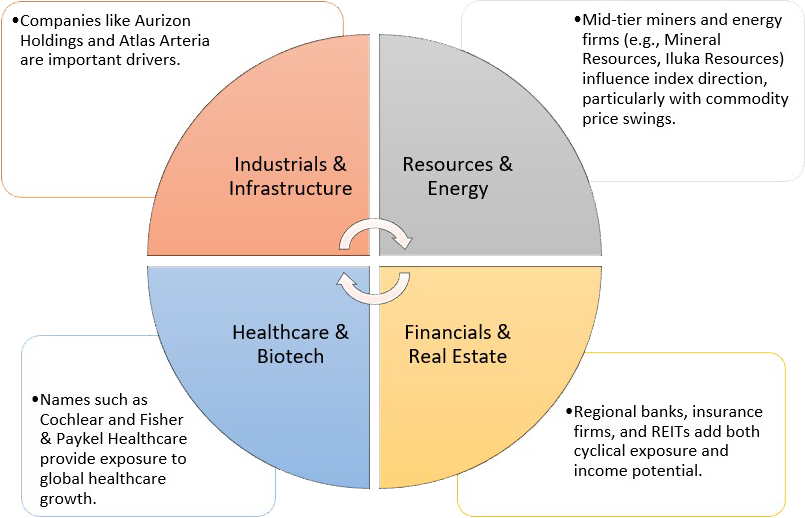
Major Contributors to the ASX MidCap 50
The XMD is less dominated by a handful of giants than the ASX 200 or ASX 300, so sector contributions are more balanced.
XMD Index Chart & Technical Analysis
ASX 50 vs ASX MidCap 50 vs Small Ordinaries
| Feature | ASX 50 | ASX MidCap 50 (XMD) | Small Ordinaries (XSO) |
|---|---|---|---|
| Companies covered | Top 50 | Ranked 51–100 | Ranked 101–300 |
| Company size | Blue chips | Established mid caps | Small caps |
| Concentration | High (banks and miners dominate) | More balanced | Broad, many small weights |
| Typical volatility | Lower | Moderate | Higher |
ASX MidCap 50 Companies List
ASX MidCap 50 Outlook
Australia's mid-cap segment is set to benefit from easing rate pressures, which could boost demand for industrials, financials and consumer names, while mid-tier miners remain leveraged to commodities critical for the energy transition. Global exposure through healthcare exporters adds diversification and defensive growth.
Key risks include interest rates staying high, weak consumer trends and commodity volatility. Overall, the XMD presents a balanced growth and income profile, appealing to investors seeking diversification beyond large-cap names.
Frequently Asked Questions
What is the ASX MidCap 50 Index (XMD)?
The S&P/ASX MidCap 50 (XMD) tracks the 51st to 100th largest companies listed on the ASX by float-adjusted market capitalisation. It sits just below the blue-chip ASX 50 and measures the performance of established mid-sized Australian companies.
How many companies are in the ASX MidCap 50?
The index contains 50 companies: the members of the ASX 100 that are not in the ASX 50. Constituents change as companies move up or down the market capitalisation rankings.
What is the difference between the ASX 50 and the ASX MidCap 50?
The ASX 50 covers the 50 largest ASX companies, such as the big four banks and major miners. The MidCap 50 covers the next 50 companies, which are smaller, often faster-growing and less dominated by a few giants.
What is the difference between the MidCap 50 and the Small Ordinaries?
The MidCap 50 covers companies ranked 51 to 100 by market value, while the Small Ordinaries (XSO) covers companies ranked 101 to 300. Small Ords stocks are smaller and usually more volatile than mid caps.
Why do investors follow mid-cap stocks?
Mid caps are often seen as a sweet spot: large enough to be liquid and established, but small enough to grow faster than blue chips. They are also more sensitive to domestic economic conditions, which makes the XMD a useful gauge of investor appetite for growth.
Conclusion
The ASX MidCap 50 index is trading near the top of its bullish uptrend, reflecting strong momentum across mid-tier resources, healthcare and industrial names. While the technical setup points to strength, the overbought RSI suggests the potential for a pause or minor correction before the next leg higher.
Long-term prospects remain constructive, with mid caps well placed to capture both cyclical recovery and structural growth. A breakout above 11,782.10 points would confirm a continuation of the rally, whereas consolidation around 10,760.30–10,967.50 points would provide healthy support for further upside.