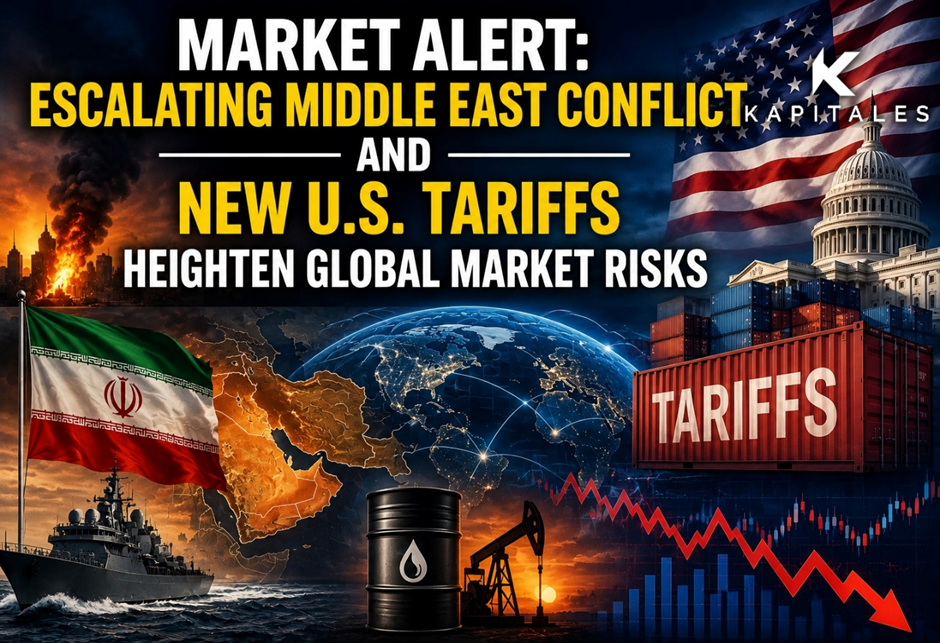
Escalating Middle East Conflict and New U.S. Tariffs Heighten Global Market Risks
Source: Kapitales ResearchExecutive OverviewGlobal financial markets are facing a renewed wave of uncertainty as geopolitical tensions in the Middle East intensify and the United States introduces fresh trade measures. Iran has rejected a U.S.-backed ceasefire proposal, while the U.S. military has confirmed its 13th consecutive night of strikes against Iranian military targets. Simultaneously, the Trump administration has announced new tariffs affecting 60 major trading partners, increasing concerns over global trade and supply chains.These developments have pushed Brent crude above US$100 per barrel for the first time since May, 2026 strengthened the U.S. dollar and reinforced inflation concerns, creating a more volatile environment for global equity markets.
Iran Rejects Ceasefire Proposal as Military Conflict EscalatesAccording to reports, Iran rejected a U.S.-supported temporary ceasefire proposal delivered through Iraqi Prime Minister Ali al-Zaidi, arguing that any agreement failing to address control of the Strait of Hormuz would not provide a lasting solution.The diplomatic setback coincides with an intensification of military operations.The U.S. Central Command (CENTCOM) confirmed that it completed its 13th consecutive night of strikes, targeting Iranian command centres, drone storage facilities, communications networks, coastal surveillance systems and maritime capabilities.President Donald Trump also warned of "major military punishment" after Iran-backed Houthi forces attacked two Saudi oil tankers in the Red Sea. The U.S. administration further stated that frozen Iranian assets could be used to compensate for damages to commercial ships and cargo affected by attacks in the region.Iran has warned that any attacks on its critical infrastructure could prompt retaliation against regional oil, gas, electricity and other strategic facilities, raising the possibility of a broader regional conflict.
Oil Prices Surge as Supply Risks IntensifyEnergy markets reacted sharply to the deteriorating geopolitical environment.
Brent crude climbed above US$100/bbl, trading near US$101.06/bbl, its highest level since May 2026.
Brent is currently on track for a 14.6% weekly gain.
WTI crude traded around US$91.20/bbl, positioning for an 11.8% weekly increase.
Concerns over global oil supply continue to grow as shipping disruptions worsen.According to Kpler shipping data:
Confirmed tanker traffic through the Strait of Hormuz has declined significantly.
Only one tanker reportedly crossed the Strait on Thursday, representing the lowest daily activity since 7 May 2026.
Security risks have also increased around the Bab el-Mandeb Strait, another strategically important oil shipping route linking the Red Sea with the Indian Ocean.
Adding to supply concerns, Kazakhstan's Energy Ministry announced that several oil producers temporarily reduced output after suspected Ukrainian drone attacks disrupted operations at the country's main Black Sea export terminal. The Caspian Pipeline Consortium (CPC) suspended oil loadings following attacks on tankers, interrupting crude shipments from Kazakhstan. The CPC export route accounts for approximately 2% of global daily crude supply.
Fresh U.S. Tariffs Add Pressure to Global TradeAlongside geopolitical tensions, the Trump administration announced new tariffs targeting 60 major trading partners over forced-labour enforcement standards.The tariff framework includes:
10% tariffs for countries that have implemented forced-labour import prohibitions.
12.5% tariffs for countries without such measures.
Countries subject to the 10% tariff include Canada, Mexico, the United Kingdom and India.The move follows recent U.S. tariff actions on Canadian goods and signals that trade policy remains an important source of uncertainty for global markets and multinational companies.
Rising geopolitical risks have supported demand for the U.S. dollar.
The U.S. Dollar Index (DXY) strengthened to approximately 101.46, its highest level since 25 June 2026.
The euro weakened after the European Central Bank maintained its benchmark interest rates.
The ECB left:
Deposit Facility Rate: 2.25%.
Main Refinancing Rate: 2.40%.
Marginal Lending Facility: 2.65%.
The central bank reiterated that future monetary policy decisions will remain data dependent while warning that the full inflationary impact of higher energy prices has yet to emerge.
What Australian Investors Should Do?
Stay disciplined and avoid reacting to short-term geopolitical headlines. Market volatility often increases during periods of conflict, making long-term investment discipline particularly important.
Closely monitor Brent crude prices, as sustained levels above US$100/bbl could continue supporting Australian energy producers while simultaneously increasing inflationary pressures across the broader economy.
Monitor gold and defensive assets, which often attract investor demand during periods of geopolitical uncertainty and heightened market volatility.
Assess inflation-sensitive sectors carefully, including retail, consumer discretionary, transport, airlines and logistics, as higher fuel and freight costs could pressure corporate margins and consumer spending.
Watch global central bank expectations. Persistently higher energy prices may keep inflation elevated, potentially delaying interest-rate cuts by major central banks and influencing the Reserve Bank of Australia's policy outlook.
Monitor movements in the Australian dollar. A stronger U.S. dollar can create additional currency volatility, affecting exporters, importers and companies with significant offshore earnings.
Pay close attention to global shipping disruptions. Reduced vessel movements through the Strait of Hormuz and increasing risks around the Bab el-Mandeb Strait could disrupt supply chains, lengthen delivery times and raise transportation costs globally.
Maintain portfolio diversification across sectors and asset classes rather than concentrating exposure in highly cyclical industries.
Consider tactical exposure to Australian energy stocks, as elevated oil prices could provide near-term support for earnings and sector performance.
Keep sufficient cash or liquidity available to capitalise on opportunities that may emerge if market volatility creates attractive valuations in fundamentally strong businesses.
ConclusionThe rejection of the ceasefire proposal, continued U.S. military operations, expanding risks to two of the world's most strategically important shipping corridors and fresh U.S. tariff measures have significantly increased global geopolitical and economic uncertainty. Brent crude trading above US$100 per barrel, alongside growing supply-chain concerns and persistent inflation risks, is likely to keep financial markets volatile in the near term. For Australian investors, maintaining diversified portfolios, focusing on fundamentally strong companies with resilient balance sheets and closely monitoring geopolitical, commodity and monetary policy developments will remain essential until there is greater clarity on the global outlook.Disclaimer for Kapitales ResearchThe materials provided by Kapitales Research, including articles, news, data, reports, opinions, images, charts, and videos ("Content"), are intended for personal, non-commercial use only. The primary goal of this Content is to educate and inform readers. This Content is not meant to offer financial advice, nor does it include any recommendation or opinion that should be relied upon for making financial decisions. Certain Content on this platform may be sponsored or unsponsored, but it does not serve as a solicitation or endorsement to buy, sell, or hold any securities, nor does it encourage any specific investment activities. Kapitales Research is not authorized to provide investment advice, and we strongly advise users to seek guidance from a qualified financial professional, such as a financial advisor or stockbroker, before making any investment choices. Kapitales Research disclaims all liability for any direct, indirect, incidental, or consequential damages arising from the use of the Content, which is provided without any warranties. The opinions expressed by contributors or guests are their own and do not necessarily reflect the views of Kapitales Research. Media such as images or music used on this platform are either owned by Kapitales Research, sourced through paid subscriptions, or believed to be in the public domain. We have made reasonable efforts to credit sources where appropriate. Kapitales Research does not claim ownership of any third-party media unless explicitly stated otherwise.
Customer Notice:
Nextgen Global Services Pty Ltd trading as Kapitales Research (ABN 89 652 632 561) is a Corporate Authorised Representative (CAR No. 1293674) of Enva Australia Pty Ltd (AFSL 424494). The information contained in this website is general information only. Any advice is general advice only. No consideration has been given or will be given to the individual investment objectives, financial situation or needs of any particular person. The decision to invest or trade and the method selected is a personal decision and involves an inherent level of risk, and you must undertake your own investigations and obtain your own advice regarding the suitability of this product for your circumstances. Please be aware that all trading activity is subject to both profit & loss and may not be suitable for you. The past performance of this product is not and should not be taken as an indication of future performance.
Disclosure: The information mentioned above has been sourced from the company reports and a third-party database, i.e. Koyfin. Investors are advised to use strict stop-loss to protect their investments in case of any unfavorable/uncertain market events.
Kapitales Research, Level 13, Suite 1A, 465 Victoria Ave, Chatswood, NSW 2067, Australia | 1800 005 780 | info@kapitales.com.au
x
Daily Dose of Buy, Sell & Hold recommendations before the market opens.
Start Your 7 Days Free Trial Now!
We use cookies to help us improve, promote, and protect our services.
By continuing to use this site, we assume you consent to this.
Read our
Privacy Policy
and
Terms & Conditions

Escalating Middle East Conflict and New U.S. Tariffs Heighten Global Market Risks
 Source: Kapitales ResearchExecutive OverviewGlobal financial markets are facing a renewed wave of uncertainty as geopolitical tensions in the Middle East intensify and the United States introduces fresh trade measures. Iran has rejected a U.S.-backed ceasefire proposal, while the U.S. military has confirmed its 13th consecutive night of strikes against Iranian military targets. Simultaneously, the Trump administration has announced new tariffs affecting 60 major trading partners, increasing concerns over global trade and supply chains.These developments have pushed Brent crude above US$100 per barrel for the first time since May, 2026 strengthened the U.S. dollar and reinforced inflation concerns, creating a more volatile environment for global equity markets.
Iran Rejects Ceasefire Proposal as Military Conflict EscalatesAccording to reports, Iran rejected a U.S.-supported temporary ceasefire proposal delivered through Iraqi Prime Minister Ali al-Zaidi, arguing that any agreement failing to address control of the Strait of Hormuz would not provide a lasting solution.The diplomatic setback coincides with an intensification of military operations.The U.S. Central Command (CENTCOM) confirmed that it completed its 13th consecutive night of strikes, targeting Iranian command centres, drone storage facilities, communications networks, coastal surveillance systems and maritime capabilities.President Donald Trump also warned of "major military punishment" after Iran-backed Houthi forces attacked two Saudi oil tankers in the Red Sea. The U.S. administration further stated that frozen Iranian assets could be used to compensate for damages to commercial ships and cargo affected by attacks in the region.Iran has warned that any attacks on its critical infrastructure could prompt retaliation against regional oil, gas, electricity and other strategic facilities, raising the possibility of a broader regional conflict.
Oil Prices Surge as Supply Risks IntensifyEnergy markets reacted sharply to the deteriorating geopolitical environment.
Concerns over global oil supply continue to grow as shipping disruptions worsen.According to Kpler shipping data:
Adding to supply concerns, Kazakhstan's Energy Ministry announced that several oil producers temporarily reduced output after suspected Ukrainian drone attacks disrupted operations at the country's main Black Sea export terminal. The Caspian Pipeline Consortium (CPC) suspended oil loadings following attacks on tankers, interrupting crude shipments from Kazakhstan. The CPC export route accounts for approximately 2% of global daily crude supply.
Fresh U.S. Tariffs Add Pressure to Global TradeAlongside geopolitical tensions, the Trump administration announced new tariffs targeting 60 major trading partners over forced-labour enforcement standards.The tariff framework includes:
Countries subject to the 10% tariff include Canada, Mexico, the United Kingdom and India.The move follows recent U.S. tariff actions on Canadian goods and signals that trade policy remains an important source of uncertainty for global markets and multinational companies.
Rising geopolitical risks have supported demand for the U.S. dollar.
The central bank reiterated that future monetary policy decisions will remain data dependent while warning that the full inflationary impact of higher energy prices has yet to emerge.
What Australian Investors Should Do?
ConclusionThe rejection of the ceasefire proposal, continued U.S. military operations, expanding risks to two of the world's most strategically important shipping corridors and fresh U.S. tariff measures have significantly increased global geopolitical and economic uncertainty. Brent crude trading above US$100 per barrel, alongside growing supply-chain concerns and persistent inflation risks, is likely to keep financial markets volatile in the near term. For Australian investors, maintaining diversified portfolios, focusing on fundamentally strong companies with resilient balance sheets and closely monitoring geopolitical, commodity and monetary policy developments will remain essential until there is greater clarity on the global outlook.Disclaimer for Kapitales ResearchThe materials provided by Kapitales Research, including articles, news, data, reports, opinions, images, charts, and videos ("Content"), are intended for personal, non-commercial use only. The primary goal of this Content is to educate and inform readers. This Content is not meant to offer financial advice, nor does it include any recommendation or opinion that should be relied upon for making financial decisions. Certain Content on this platform may be sponsored or unsponsored, but it does not serve as a solicitation or endorsement to buy, sell, or hold any securities, nor does it encourage any specific investment activities. Kapitales Research is not authorized to provide investment advice, and we strongly advise users to seek guidance from a qualified financial professional, such as a financial advisor or stockbroker, before making any investment choices. Kapitales Research disclaims all liability for any direct, indirect, incidental, or consequential damages arising from the use of the Content, which is provided without any warranties. The opinions expressed by contributors or guests are their own and do not necessarily reflect the views of Kapitales Research. Media such as images or music used on this platform are either owned by Kapitales Research, sourced through paid subscriptions, or believed to be in the public domain. We have made reasonable efforts to credit sources where appropriate. Kapitales Research does not claim ownership of any third-party media unless explicitly stated otherwise.
Customer Notice:
Nextgen Global Services Pty Ltd trading as Kapitales Research (ABN 89 652 632 561) is a Corporate Authorised Representative (CAR No. 1293674) of Enva Australia Pty Ltd (AFSL 424494). The information contained in this website is general information only. Any advice is general advice only. No consideration has been given or will be given to the individual investment objectives, financial situation or needs of any particular person. The decision to invest or trade and the method selected is a personal decision and involves an inherent level of risk, and you must undertake your own investigations and obtain your own advice regarding the suitability of this product for your circumstances. Please be aware that all trading activity is subject to both profit & loss and may not be suitable for you. The past performance of this product is not and should not be taken as an indication of future performance.
Disclosure: The information mentioned above has been sourced from the company reports and a third-party database, i.e. Koyfin. Investors are advised to use strict stop-loss to protect their investments in case of any unfavorable/uncertain market events.
Kapitales Research, Level 13, Suite 1A, 465 Victoria Ave, Chatswood, NSW 2067, Australia | 1800 005 780 | info@kapitales.com.au